Thursday, 6 June 2013

Sydney Terminal Building, Central Railway Station

The Sydney Terminal Building along Eddy Avenue is part of Central railway station, This heritage listed building was built in 1906 in the Federation Free Classical architectural style. The building comprises of a sandstone colonnade and porte cochere, which originally provided an undercover area for passengers transferring to and from trams and is now used for the Metro Light Rail. This terminus is also the largest junction in Sydney for city and country trains.

Wednesday, 5 June 2013

Walsh Bay, apartments

A view of Pier 7 at Walsh Bay, in the inner city suburb of Millers Point. These warehouses and wharves at Walsh Bay were once part of Sydney's port facilities but have been converted to apartments. Residents moor their boats in this marina along Pier 7.

Tuesday, 4 June 2013

Millers Point, townhouses

This heritage listed property is located on Lower Fort Street, in the inner city suburb of Millers Point. These townhouses were built in the 1830s in the Regency architectural style, based on the London model of three storeys with basements. A vintage, cast iron, red painted pillar post box is located on the footpath outside.

Monday, 3 June 2013

Millers Point, Towns Place North

Towns Place North is a building located along Towns Place, in the inner city suburb of Millers Point. The two storey timber-framed weatherboard building was built in 1910 as a detached office building for the port facilities at Walsh Bay. It has been restored as part of the as part of the Walsh Bay Urban Renewal Project. A view from the other side can be seen here.

Sunday, 2 June 2013

The Rocks, public lavatory

This heritage listed public lavatory is located along George Street at The Rocks. Made from decorative cast iron panels, the structure contains two urinals. Built in the 1880s in the Victorian Italianate style, it was originally located on Obsevatory Hill before being moved to this location under the Sydney Harbour Bridge, near Dawes Point.
 Linked to: Shadow Shot Sunday

Saturday, 1 June 2013

Dawes Point, ablutions block (Theme Day: The Beauty of Decay)
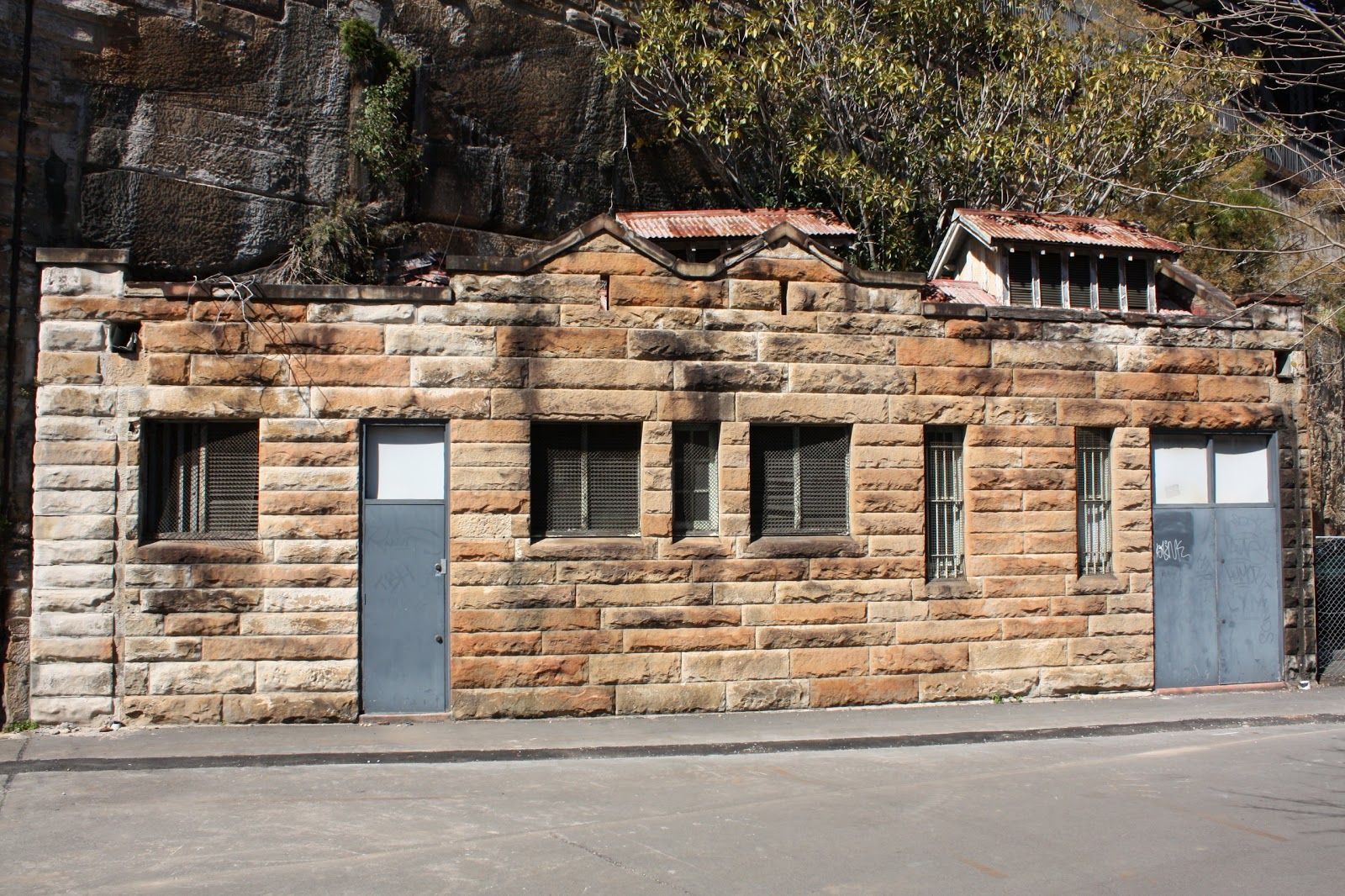
This sandstone building is located along Hickson Road, opposite the wharves at Walsh Bay, in the inner city suburb of Dawes Point. Although I'm not exactly sure what its original purpose was, I think it must have been an ablutions block, where wharf labourers could clean up after their day's work. The architectural design is very similar to a former ablutions block which is down the road at Millers Point, now used as a cafe which can be seen here. This building could possibly be waiting to also be converted into a trendy cafe with outdoor seating someday.
Click here to view thumbnails for all participants of this theme day

Thursday, 30 May 2013

Walsh Bay, Vivid Festival, Nymphaea Nelumbo

"Nymphaea Nelumbo" is an artwork floating in Walsh Bay between the wharves in the inner city suburb of Dawes Point. It was created by Thomas Cole, Felicia Huang and Rosenell Serrano for the Vivid Sydney Festival, running from 24 May to 10 June 2013. The Lotus Plant sculptures have been created from recycled road and maritime signage around Sydney Harbour. The plants are fitted with solar panels and LED lighting.
 Linked to: Signs, Signs.

Wednesday, 29 May 2013

Botanic Gardens, Lotus Pond

The Lotus Pond is located in the Royal Botanic Gardens and is linked to the Main Pond. The lotus or water lilies that surround the fountain in the middle of the pond are brown and dying off at this time of year. To view the lilies green and thriving in summer see here. To view the pond without the lillies in winter see here.

Tuesday, 28 May 2013

Botanic Gardens, The Boxers

This is one of a pair of marble statues known as "The Boxers", located in the Royal Botanic GardensThis two-metre high sculpture is a copy of "The Greek Boxer Damoxenos" by Antonio Canova which was completed in 1800 and is now in the collection at the Vatican MuseumThe copy of "The Greek Boxer Kreugas" by Antonio Canova can be seen here. The two engaged in a boxing match at the Nemea Games, where Damoxenos killed Kreugas. The referee disqualified Damoxenos and declared the dead Kreugas the winner. These statues were made in Italy and installed in the Botanic Gardens in the 1880s.

Monday, 27 May 2013

Botanic Gardens, First Farm

This scarecrow is part of the First Farm display in the Royal Botanic Gardens. It features plants that originally grew on the site of the first farm established by European settlers near this site at Farm Cove.

Sunday, 26 May 2013

Botanic Gardens, A Folly for Mrs Macquarie

This folly is located in the Royal Botanic Gardens with the city skyline as a backdrop. "A Folly for Mrs Macquarie" was created by Fiona Hall and installed in 2000 at the possible site of an original folly. The Royal Botanic Gardens were developed from 1816 under the direction of Elizabeth Macquarie, the second wife of Governor Lachlan Macquarie. A folly is a building or structure that is created primarily for decoration. For a view in the other direction across Sydney Harbour to Mrs Macquaries Point see here.

Saturday, 25 May 2013

Darling Harbour, HMAS Advance

The HMAS Advance is a navy patrol boat on permanent display at the Australian National Maritime Museum at Darling Harbour. It was commissioned in 1968 and served out of Darwin, Northern Territory until 1980. The larger ship behind it is the HMAS Vampire, a navy destroyer, The office buildings of the city rise up behind them.

Friday, 24 May 2013

Mosman, Sydney skyline

This view across Mosman Bay on Sydney Harbour to the Sydney skyline is from Taronga Zoo, in the north shore suburb of Mosman. The clouds rolled in over the city in the afternoon on an otherwise clear blue day.

Thursday, 23 May 2013

Mosman, Taronga Zoo

The upper entrance to Taronga Zoo, in the north shore suburb of Mosman. Sydney's original zoo was established in 1800 on seven acres of land at Billy Goat Swamp in Moore Park. By the beginning of the 20th century, the Zoo had outgrown its site and plans were made to exchange the land to Aston Park at Mosman. Taronga Zoo was officially opened on 7 October, 1916. Taronga is an Aboriginal word meaning beautiful view.

Wednesday, 22 May 2013

Balgowlah Heights, Forty Baskets Beach, baths

The view from the baths at Forty Baskets Beach, in the northern suburb of Balgowlah Heights. The beach is named after a catch of 40 baskets of fish sent to a contingent of New South Wales troops detained at the nearby North Head Quarantine Station after returning from Sudan in 1885. The boats are moored in North Harbour, one of the three harbours that make up Port Jackson. In the distance is a ferry at Manly Ferry wharf, on Manly Cove.

Tuesday, 21 May 2013

Glebe, post office

The former Glebe post office is located on the corner of Glebe Point Road and St Johns Road, in the inner west suburb of Glebe. It was designed by James Barnet and built around 1890 in the Victorian Free Classical architectural style.
Linked to: Ruby TuesdayOur World Tuesday.

Monday, 20 May 2013

Zetland, Nuffield Park

Nuffield Park is located in the inner city suburb of Zetland. These curious rusty iron sculptures separate the terraces stepping down from Ascot Avenue.

Sunday, 19 May 2013

Balgowlah, The Norwegian Seamen's Church (Theme Day: Norwegian Constitution Day)

The The Norwegian Seamen's Church is located along White Street in the northern suburb of Balgowlah. Sjømannskirken - the Norwegian Church Abroad - was founded in 1864 and established to secure the moral and religious education of Scandinavian seafarers. This historic building known as "Whitehall", was built in the 1870s in the Victorian Rustic Gothic style and thought to be the oldest surviving house in Balgowlah. It was once the home of Australia's first prime minister Edmund Barton and was a private residence until it became a church in 2004.
Related Posts Plugin for WordPress, Blogger...