The eastern suburb of La Perouse, on the northern headland of Botany Bay, was named after the French navigator Jean-François de Galaup, comte de Lapérouse (1741-88). His expedition landed in the bay in January 1788, a few days after the First Fleet of convicts arrived from Britain to establish a colony in Australia. King Louis XVI of France had commissioned Lapérouse to explore the Pacific on a scientific voyage, inspired by the voyages of Captain James Cook. The Laperouse Monument is an obelisk built by the French in 1825 in what is now the Botany Bay National Park, overlooking Frenchmans Bay.
Sunday, 10 October 2010
Saturday, 9 October 2010
La Perouse, Macquarie Watchtower
The La Perouse peninsula is the northern headland of Botany Bay and Macquarie Watchtower in the Botany Bay National Park is the oldest building in the area. It is a sandstone tower constructed in 1820-22 as part of the accommodation for a small guard of soldiers that were stationed here to prevent smugglers from entering Botany Bay. The watchtower stayed in use until 1904.
Friday, 8 October 2010
Thursday, 7 October 2010
King Street Wharf, Sydney skyline
This view of King Street Wharf at Darling Harbour with the Sydney skyline in the background is from Sydney Wharf at Pyrmont.
Labels:
boats,
City,
Darling Harbour,
offices,
Sydney Tower,
towers,
wharves
Wednesday, 6 October 2010
Darling Harbour, The SubWharfyen
The SubWharfyen is a sculpture located on the end of piers 8 & 9 of Sydney Wharf, on Darling Harbour at Pyrmont. This stainless steel sculpture, created by Braddon Snape in 2008, depicts the relationship between people and the sea. Barangaroo, is the area on the opposite side of Darling Harbour that is currently under construction, on the foreshore of the Sydney Central Business District.
Tuesday, 5 October 2010
Bridge Lane, Rush
Bridge Lane features a couple of artworks from 'Are You Looking At Me? Laneway Art' which is part of Art and About Sydney festival. 'Rush' by Nike Savvas, features thousands of multi-coloured strands that create a ceiling in the lane and blow in the wind. At the end of the laneway, the other artwork is actually located in Tank Stream Way. 'For Rent' by Rocket Mattler represents a house from a time when things were less complex. It also includes a sign, a bit further away, that reads 'Room for Rent. Apply Opposite'. I managed to catch a wedding party just as they were departing in their vintage cars. This laneway, with or without the artwork, was an interesting spot for their wedding photos.
Monday, 4 October 2010
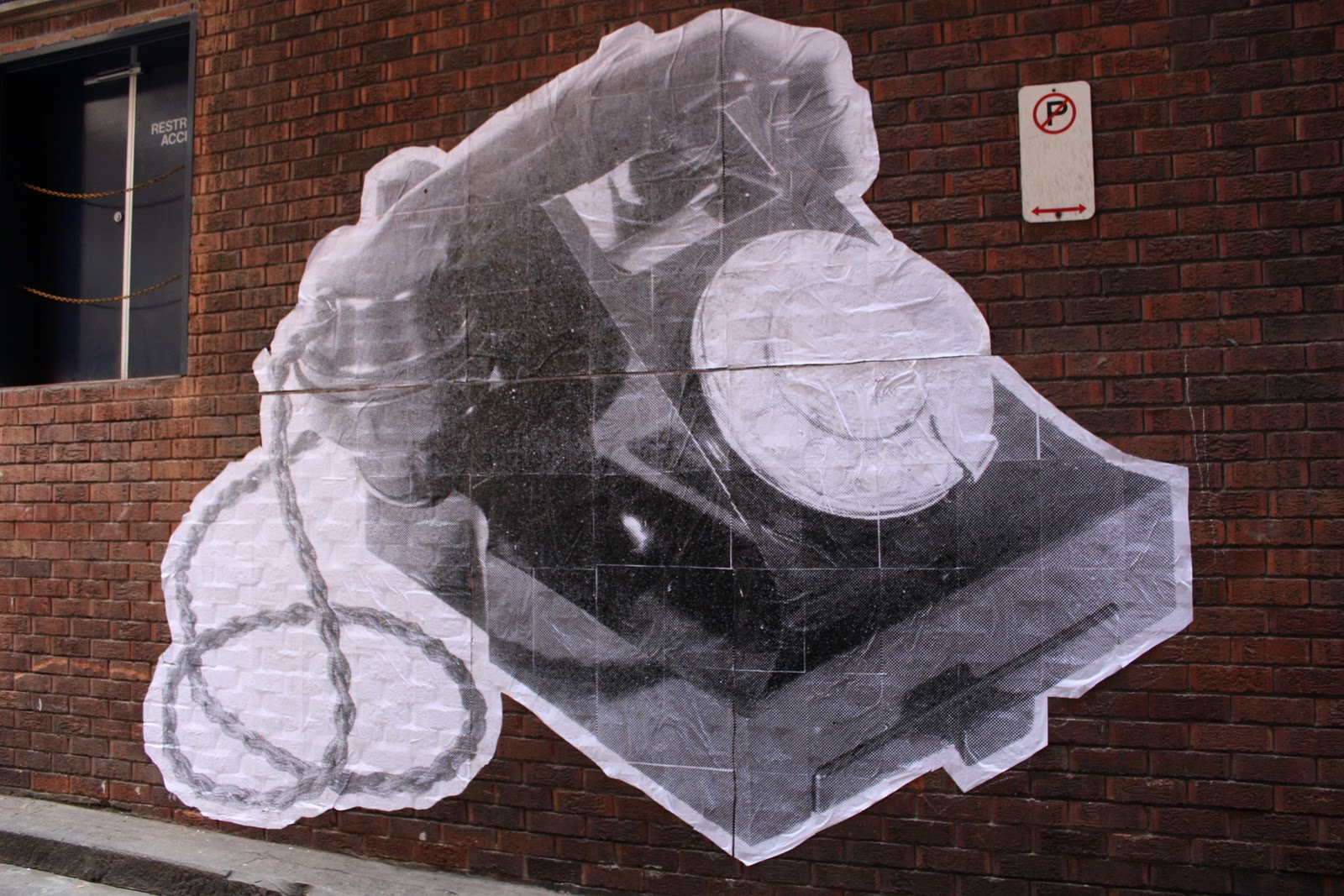
Underwood Street, Woodwork
Underwood Street is a laneway behind Dalley telephone exchange. Underwood is also the name of a famous brand of typewriter manufactured in the early 20th century. Paste Ups are a form of street art, where images on paper are cut out and pasted onto a wall.Woodwork by Simon Yates features photocopies of old fashioned typewriters and old fashioned dial telephones with a similar shape. It contains messages hidden in the keyboards of the typewriters and number dials of the phones. This ia another exhibit in Are You Looking At Me? Laneway Art' which is part of the Art and About Sydney festival. You can also the remnants of some graffiti in the last shot which is a reminder that this was the location of the Grasshopper Bar, which operated here during last year's festval.
Sunday, 3 October 2010
Wynyard Lane, HAR BOUR VIEW
This artwork HAR BOUR VIEW, by Jon Campbell is a large scale text banner hanging on the side of a sky bridge, that links two buildings over Wynyard Lane. A view of Sydney Harbour is something desirable but the location of this artwork is clearly not a harbour view, so it encourages people to think about other views. 'Are You Looking At Me? Laneway Art' is part of the Art and About Sydney festival running from 23 September to 24 October 2010.
Saturday, 2 October 2010
Temperance Lane, Circle/s in the Round for (Miles and Miles + 1)
This artwork which is created from flashing neon lights is located in Temperance Lane, off George Street. 'Circle/s in the Round for (Miles and Miles +1)' by Newell Harry, takes its title from the 1967 Miles Davis album, 'Circle in the Round'. The pulsating concentric circles are a visual homage to Davis and the encoded word-pun is supposed to remain undisclosed. My guess is 'Never Odd Or Even'. It is one exhibit in 'Are You Looking At Me? Laneway Art', which is part of the Art and About Sydney festival which is running from 23 September to 24 October 2010. The coloured lights also create a good reflection aon the 'For Sale' sign on the adjacent building in the laneway.
Friday, 1 October 2010
Newtown, street art (Theme Day: Graffiti)
I ventured to the inner city suburb of Newtown for some attractive graffiti to feature on this theme day. This artwork appears on the side of a furniture shop on the corner of King Street and Rochford Street. Newtown is a very colourful inner city suburb where many students, bohemians, hippies and yuppies make their home. It's also a very multicultural suburb but I'm not sure why they have specifically chosen to depict Latino characters here. Anyway, my best attempt for translations of these Spanish messages across this wall are "What's Happening!", "Newtown...My Neighbourhood" and "He's Crazy!".
Click here to view thumbnails for all participants of this theme day
Thursday, 30 September 2010
Park Street, Sydney 2000 Olympics, 10th anniversary banners
These banners hanging from the lamp posts in Park Street promote the 10th anniversary of the Sydney Sydney 2000 Summer Olympics. The City Banner Program is administered by the City of Sydney council. The banners are used to visually enhance the city’s streetscape and to promote cultural, tourism, sporting, retail and community events. There are close to 2000 banner locations in the city in prominent positions.
Wednesday, 29 September 2010
Lumiere, fountain
This fountain is located outside the Bathurst Street entrance of Lumiere, a new residential and commercial building. It looks best at night, lit up with colours.
Tuesday, 28 September 2010
Sydney Town Hall, Sydney 2000 Olympics, 10th anniversary celebrations
The Sydney Town Hall this week featured light projections to celebrate of the 10th anniversary of the Sydney 2000 Olympic and Paralympic Games. The theme of the display was "The Best Olympic Games Ever", a declaration made after the games by Juan Antonio Samaranch, President of the International Olympic Committee. It was created as a thank you to the thousands of volunteers who participated in the games. A cauldron also burnt brightly at the entrance of the town hall.
Monday, 27 September 2010
Darling Harbour, Endeavour replica
The Endeavour replica is moored outside the Australian National Maritime Museum at Darling Harbour. This is a replica of the HMB Endeavour, the ship commanded by Captain James Cook the English explorer, navigator and cartographer. He led an expeditition in 1768-71, which navigated and mapped the eastern coastline of Australia. Construction of the Australian-built replica began in 1988 and it was launched in 1993. It has sailed twice around the world and the museum maintains it for the public to experience 18th-century square-rig voyaging and seamanship. It now circumnavigates Australia and berths in many ports where it opens to the public.
Sunday, 26 September 2010
Endeavour Bridge
Endeavour Bridge carries General Holmes Drive across the Cooks River between Mascot and Kyeemagh, close to Botany Bay. It is named after the HMB Endeavour, the ship commanded by Captain James Cook, an English explorer, navigator and cartographer. The crew of the Endeavour arrived in Botany Bay in 1770 and was the first recorded European expedition to navigate and map the eastern coastline of Australia.
Saturday, 25 September 2010
Friday, 24 September 2010
Kyeemagh, Cooks River
A view of the sunset behind the Cooks River in the southern suburb of Kyeemagh from Endeavour Bridge, looking towards the suburbs of Banksia and Arncliffe.
Thursday, 23 September 2010
Darling Harbour, Vernon Mooring Anchors
This Vernon Mooring Anchors stand as a monument outside the Australian National Maritime Museum, near the Pyrmont Bridge. They are a memorial to seafarers lost at sea in wartime and in peace. These Admiralty-pattern anchors were originally from the 1839 wooden sailing ship, NSS Vernon. After 1867, the Vernon was converted into a nautical school ship and permanently moored off Cockatoo Island. The anchors were installed here in 1992.
Wednesday, 22 September 2010
Pyrmont Bay, ferry wharf
The Pyrmont Bay Wharf is located beside the Australian National Maritime Museum at Darling Harbour. The Charlotte is a First Fleet Class ferry acquired in 1985, which is part of the Sydney Ferries fleet that operates on the Inner Harbour. It was named Charlotte, after one of eleven ships of the First Fleet that sailed to Australia in 1787.
Tuesday, 21 September 2010
Darling Harbour, Welcome Wall
The Welcome Wall, a memorial which honours immigrants to Australia, is located outside the Australian National Maritime Museum at Darling Harbour. The Welcome Wall is a 100 metre long bronze wall, inscribed with names of immigrants, their arrival dates and the place they came from. It is located near Pyrmont docks, where millions of new settlers first stepped ashore in Australia. Over the years, more than six million people have crossed the world to settle in Australia.
Monday, 20 September 2010
Darling Harbour, The Millennium Athlete
This week Sydney has been celebrating the 10th anniversary of the Sydney 2000 Summer Olympic Games, which opened on the 15 September 2000. This steel sculpture of the logo sits outside the Sydney Convention and Exhibition Centre at Darling Harbour, which was one of the venue sites. The plaque explains the story behind it: “The Millennium Athlete” logo for the Sydney 2000 Olympic Games, was unveiled on 14 September 1996 by some of our greatest Olympians. This sculpture represents the promise made in Sydney’s Olympic bid to host the Games that would be dedicated to the athletes of the world. The running athlete symbolises, the spirit of Sydney, the Olympic torch bearer and Australia’s indigenous culture. The twelve metre mast supports nearly two tonnes of steel suspended six metres above the ground on a total of 120 metres of special high-tensile woven steel cable.
Sunday, 19 September 2010
Botanic Gardens, bridge
A view of one of the bridges across the Main Pond of the Royal Botanic Gardens.
Labels:
Botanic Gardens,
City,
offices,
ponds,
Sydney Tower,
trees
Saturday, 18 September 2010
Botanic Gardens, Lotus Pond
The Lotus Pond is located beside the Oriental Garden, close to the Palm Grove Centre, in the Royal Botanic Gardens. The fountain in the centre, known as the Bird Bath Fountain, was likely installed some time before 1879 for the International Exhibition. Due to damage, it was replaced in 1987 using a marble bowl sourced from Carrera in Italy. There were quite a few flying foxes (or fruit bats) sleeping in the trees above.
Friday, 17 September 2010
Sydney Conservatorium of Music
The Greenway Building of the Sydney Conservatorium of Music built in 1821, was commissioned by Governor Lachlan Macquarie as the stables for the nearby Government House of New South Wales, adjacent to the Royal Botanic Gardens. It was designed by Francis Greenway and in the Old Colonial Gothick Picturesque style. It became the NSW State Conservatorium of Music in 1916 and is now part of the University of Sydney. This building and a brilliant blue sky are seen here reflected in the glass of a skylight for the underground levels of the school. A side view of the building can be seen here.
Thursday, 16 September 2010
Botanic Gardens, Boy Extracting Thorn
This sculpture on a rocky outcrop in the Royal Botanic Gardens is called 'Boy Extracting Thorn'. It was one of the statues imported from Italy in 1883. This is a marble copy of the famous 'Boy With Thorn' (also known as Fedele, Fedelino or Spinario), a bronze Hellenistic statue that was given to the city of Rome by Pope Sixtus IV in the 1471, creating the Palazzo dei Conservatori.
Wednesday, 15 September 2010
Botanic Gardens, A Folly for Mrs Macquarie
"A Folly for Mrs Macquarie" is a sculpture in the Royal Botanic Gardens with breathtaking views of Farm Cove and Sydney Harbour. In architecture, a folly is an extravagant decorative structure designed more for artistic expression than practicality. The Royal Botanic Gardens were developed from 1816 under the direction of Elizabeth Macquarie, the second wife of Governor Lachlan Macquarie. This work was created by Fiona Hall and installed in 2000 at the possible site of an original folly which looks across to Mrs Macquaries Point. Constructed from wrought iron and sandstone, it makes a statement about the follies of white settlement. It depicts a raised arm and clasped dagger from Macquarie's crest, a domed roof of metal Norfolk Island Pine fronds and an underlying, a ceiling of bones representing the animals that once lived in this area, barbed wire walls and an entrance bounded by an axe and scythe.
Tuesday, 14 September 2010
Botanic Gardens, La Ballarina
La Ballarina is a sculpture that sits in a flower bed in the Royal Botanic Gardens. It was one of eight statues purchased for the new Palace Garden in 1883. La Ballarina was sculpted by Charles Summers, a successful Australian sculptor living in Carrara, Italy and was a copy of a work by Antonio Canova, which has since been lost. These Italian statues fell victim to changing attitudes that saw many of the more flagrant nudes removed in the 1910s and later destroyed as a 'menace to public morals'. Others were removed from public view in the 1970s when the mass replication of classical statuary in suburban gardens made the works seem 'low-brow'. The surviving statues were kept in the Stoneyard, known as the 'Graveyard', behind the Succulent Garden. La Ballarina was the first of the Italian marbles to be reconstructed with a new head, hand and foot sculpted by Polish-born mason Jacek Luszczyk from photos provided by the the Canova Foundation in Italy and unveilled in 2009.
Monday, 13 September 2010
Chifley Square, sculpture
This enourmous sculpture of Ben Chifley, Labor Prime Minister from 1945 to 1949, was created by Simeon Nelson and installed in 1997. It stands in Chifley Square beside Chifley Tower, which were named after this prime minister. This artwork which stands over 9 metres is a cartoon line drawing cut from two flat sheets of stainless steel, narrowly separated by a truss, creating a two dimensional pop art sculpture. It was derived from a small grainy photo of Ben Chifley posing for a group portrait with members of British Prime Minister Atlee’s cabinet in 1947. The wall of glass in the background which is an extension of the outdoor cafe's rear wall is called Lightwall Crucimatrilux.
Sunday, 12 September 2010
Sydney Harbour Bridge, Pier One
This view of the Sydney Harbour Bridge and Pier One at Dawes Point at sunset is from Pier 2/3 wharf on Walsh Bay.
Saturday, 11 September 2010
Cockle Bay, Sydney skyline
Cockle Bay Wharf, the Darling Harbour Marina and Sydney skyline reflections in Cockle Bay. The three white office buildings are Darling Park Towers.
Linked to: Weekend Reflections.
Labels:
bays,
City,
Darling Harbour,
offices,
Sydney Tower,
towers
Subscribe to:
Posts (Atom)