Tuesday, 23 November 2010

Tamarama, Sculpture by the Sea

Bondi Venus by Dennis Kalous, Australia

Idol For A Bull Market by Daniel Clemett, Australia
Still Life by Sang-Bong Lee, South Korea
Earth Fish by Daniel Wallwork, Australia
Sitting Hen by Tae-Geun Yang, South Korea
Sculpture by the Sea is the world's largest annual free public outdoor sculpture exhibition. It is located on the two kilometre coastal walk from Bondi to Tamarama. These sculptures were located on the sandy beach at Tamarama, with the Pacific Ocean as a backdrop.

Monday, 22 November 2010

Tamarama, Sculpture by the Sea

Jolly Giants by Steve Croquett, Australia
Crossroad by Stephen Marr, Australia
The Keeper by Philippe Moreau, Australia
Le Bao by Mathieu Venon, New Caledonia
Life Boy by Paul Caporn, Australia
Sculpture by the Sea is the annual exhibition which is located on the coastal walk from Bondi to Tamarama. These are some of the more unusual artworks along the walkway at Tamarama.

Sunday, 21 November 2010

Bondi, Sculpture by the Sea

Coast Guard by Greg James, Australia

Sculpture by the Sea  is an annual exhibition which is located on the coastal walk from Bondi to Tamarama. This sculpture was located on the top of the scenic cliff at Bondi, overlooking the Pacific Ocean. The walkway leading up to Marks Park at Tamarama can be seen in the background crowded with walkers, along with some of the other artworks I have featured in past posts.


Saturday, 20 November 2010

Tamarama, Sculpture by the Sea

Wind Stone – Earth and Sky by Koichi Ishino, Japan
The Dancer by Jeramie Carter, Australia
Cycle 90° “A Premonition of Wind” III by Kaoru Matsumoto, Japan
Oueshi Zokei 2010 Circle by Keizo Ushio, Japan
Blackheath Woman by Clara Hali, Australia
Sculpture by the Sea is an annual exhibition which is located on the coastal walk from Bondi to Tamarama. These sculptures at Tamarama either have the Pacific Ocean as a backdrop or have it reflected on their shiny surfaces.

Friday, 19 November 2010

Bondi, Sculpture by the Sea

Such Sweet Thunder by Richard Heinrich, USA
Sculpture by the Sea is an annual exhibition which is located on the coastal walk from Bondi to Tamarama. This sculpture was located at a fork in the walkway at Bondi, with a terrific backdrop of the Pacific Ocean under light wisps of clouds in the sky.
Click here to view all participants of Skywatch Friday

Thursday, 18 November 2010

Tamarama, Sculpture by the Sea

Dreams of Ordinary People by Peter Tilley
Erl King by Sir Anthony Caro, England
A French Litter by Geoff Harvey, Australia
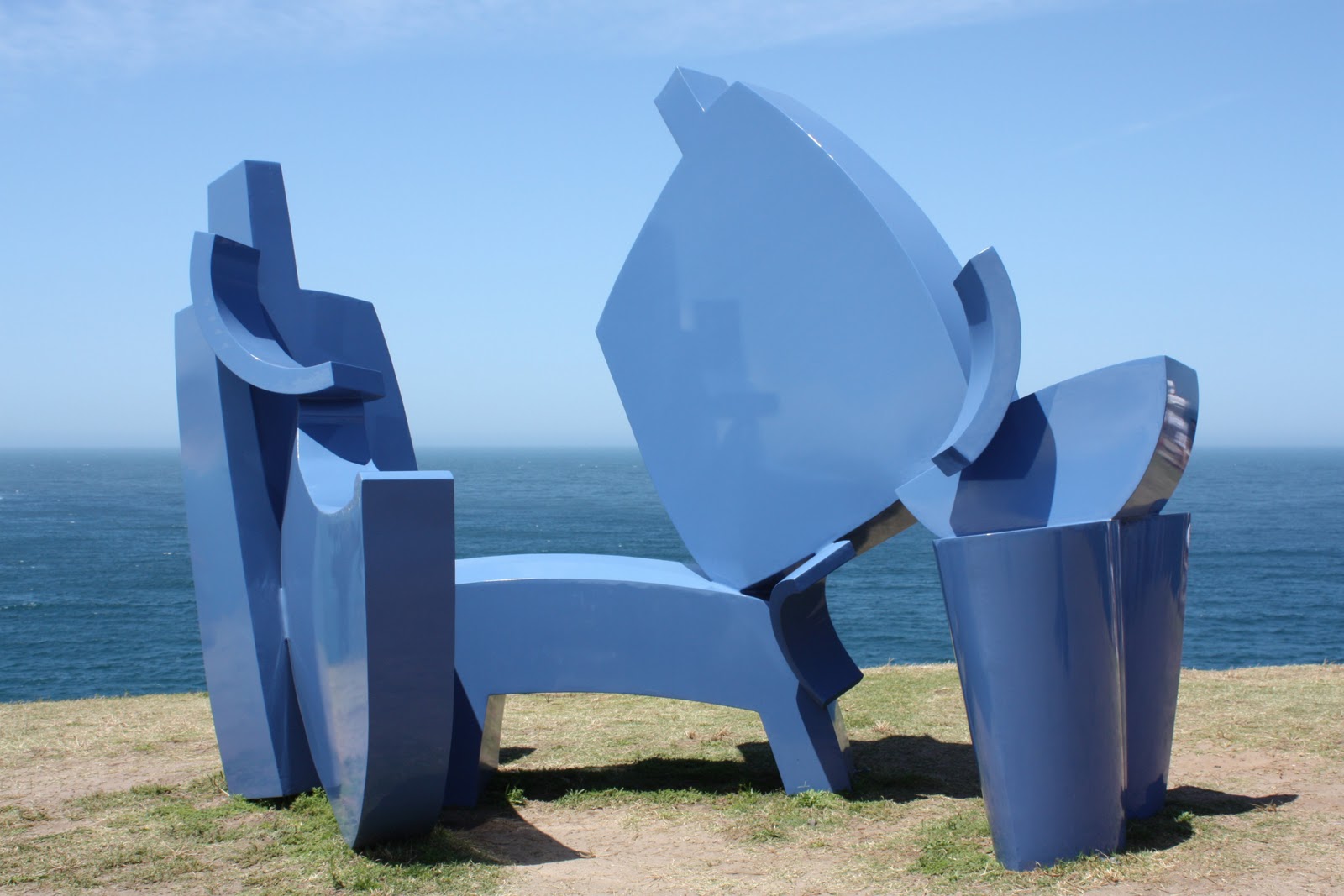
At The Table: Are We Sitting Comfortably? by Sally Kidall, Australia
Shell by Stephen Tero, Australia
Continuing my look at Sculpture by the Sea, the annual outdoor sculpture exhibition which was located on the two kilometre coastal walk from Bondi to Tamarama. These sculptures along the cliffs were overlooking Bondi Bay and the Pacific Ocean.

Wednesday, 17 November 2010

Tamarama, Sculpture by the Sea

m.100901 by Toshio Iezumi, Japan
Initialis by Tim MacFarlane
Pauanui by Jacek Wankowski, Australia
Anaconda by Michael Le Grand
Big Bather by James Rogers, Australia
Sculpture by the Sea is the world's largest annual free public outdoor sculpture exhibition which this year ran from 28th October to 14th November 2010. It was located on the two kilometre coastal walk from Bondi to Tamarama. These sculptures along the cliffs were overlooking MacKenzies Bay and had the Pacific Ocean as a backdrop.

Tuesday, 16 November 2010

Tamarama, Sculpture by the Sea

Underwater Cathedral by Orest Keywan, Australia
Transfiguration “Link” XXIII by Mitsuo Takeuchi, Japan
Untitled by Jeanne Pierre Rives, France
In Balance: Together Series by R.M. (Ron) Gomboc, Australia
Sculpture by the Sea is the world's largest annual free public outdoor sculpture exhibition. The 14th annual Sculpture by the Sea exhibition ran from 28th October to 14th November 2010.  It was located on the two kilometre coastal walk from Bondi to Tamarama. These sculptures at Marks Park in Tamarama have the Pacific Ocean and Waverley as a backdrop.
Click here to view all participants of My World Tuesday

Monday, 15 November 2010

Tamarama, Sculpture by the Sea

The Adaptable Migrant by Suzie Bleach and Andy Townsend, Australia
Caravela by Philip Spelman, Australia
Centripetal by Matthew Harding, Australia
Wind of Change by Bob Emser, USA
Wind for Tomorrow by Hiroyuki Kita, Japan
Sculpture by the Sea is an outdoor sculpture exhibition that ran from 28th October to 14th November 2010. It is located on the two kilometre coastal walk from Bondi to Tamarama. These sculptures at Marks Park in Tamarama, have North Bondi and the Pacific Ocean as a backdrop.

Sunday, 14 November 2010

Tamarama, Sculpture by the Sea

Splash by Tomas Misura, Australia
Entering The Exit by Braddon Snape, Australia
From Optimism To Hope by Andrew Rogers, Australia
The Amplitude by Christopher Vassallo, Australia
Everything Changes Everything Returns By George Andric, Australia
Sculpture by the Sea is the world's largest annual free public outdoor sculpture exhibition. It is located on the two kilometre coastal walk from Bondi to Tamarama. The 14th annual Sculpture by the Sea exhibition has been running from 28th October to 14th November 2010. These sculptures at Marks Park in Tamarama have Bondi Beach and North Bondi as a backdrop.

Saturday, 13 November 2010

Darling Harbour, Coming and Going

"Coming and Going" is a stainless steel sculpture created by Sasha Reid  in 2006, which depicts a chain of paper dolls and commemorates child migrants. It has been installed in an area behind the Australian National Maritime Museum in the inner city suburb of Pyrmont, where visiting school groups often gather. The plaque reads: This memorial is dedicated to the child migrants from the United Kingdom and Malta who had to leave their families and country of birth during the years 1912-1967. After arriving by ship, these children faced an unknown future in New South Wales. Many endured personal hardships, some experienced great suffering. They and their families have made and continue to make a valuable contribution to their communities and to Australia.  
 Linked to: Weekend Reflections

Friday, 12 November 2010

Darling Harbour, Cape Bowling Green lighthouse

The Cape Bowling Green lighthouse is located at the Australian National Maritime Museum, at Darling Harbour. It was originally built in 1874 at Cape Bowling Green, a low sandy spit 70 kilometres south of Townsville, Queensland. It was one of 22 identical lighthouses built on the North Queensland coast to guide vessels around the Great Barrier Reef, where many ships had run aground. The frame of this 22 metre high lighthouse was built from local hardwood and clad with iron plates from Britain. It was staffed by a keeper and three assistants and moved twice, in 1878 and 1908, when threatened by the sea. In 1913, an incandescent mantle was installed, fuelled by vapourised kerosene. It was destaffed in 1920 when an automatic acetylene light was installed, operated by a sun valve. It was replaced by a modern tower in 1987 and then transported to the north wharf of the maritime museum in Sydney in 1994.

Thursday, 11 November 2010

Darling Harbour, signal mast

This signal mast is located at Darling Harbour, beside the Australian National Maritime Museum. It was originally erected at the Royal Australian Navy's Garden Island Dockyard in 1912, with pennants or signal flags flown from it displaying messages to naval vessels in Sydney Harbour. It stood at 72 metres but in World War II had the middle section removed because it was a hazard to sea planes taking off from Rose Bay. It was reconstructed here in 1991 and now stands at 20.7 metres. The Australian national flag, the museum flag, the principal sponsor’s flag, the Aboriginal and Torres Strait Islander flags are flown from it every day. On special days, signal flags are flown from the mast to display messages.

Wednesday, 10 November 2010

Australian National Maritime Museum

The Australian National Maritime Museum at Darling Harbour, viewed from the boardwalk beside Pyrmont Bay. The Australian National Maritime Museum was designed by Phillip Cox and opened in 1991. The museum houses exhibitions that explore Australia's links with the sea and how maritime activities and issues have shaped the lives of people in Australia. The Pyrmont Bay ferry wharf, the museum's Welcome Wall and the Cape Bowling Green Lighthouse can be seen from here.

Tuesday, 9 November 2010

Millers Point, Holy Trinity School

This heritage sandstone building was originally the Holy Trinity School, in the inner city suburb of Millers Point. A school was begun at this site in 1844 and this school house was built in 1850. It was last used as a primary day school in 1942 and is now used as the parish hall for The Garrison Church that I featured yesterday. 

Monday, 8 November 2010

Millers Point, The Garrison Church

The Garrison Church is a heritage building located at the corner of Lower Fort Road and Argyle Street, in inner city suburb of Millers Point. The church was built in the early 1840s from sandstone quarried in nearby Argyle Street, known as the Argyle Cut. It was officially called the Holy Trinity Church and was the colony's first military church for soldiers from the military garrison at Dawes Point.

Sunday, 7 November 2010

Woolloomooloo, Finger Wharf, boardwalk

The Woolloomooloo Finger Wharf on Wooloomooloo Bay is the largest timbered-piled building in the world. The wharf and warehouse building were originally completed in 1915. This area was a working port until the 1970s. The wharf was redeveloped in the 1990s into a hotel, apartments, restaurants and marina. This boardwalk linked to the wharf by these little bridges provides an extended walkway.

Saturday, 6 November 2010

Potts Point, Woolloomooloo Bay, HMAS Newcastle

The HMAS Newcastle (FFG 06) is an Adelaide class guided-missile frigate of the Royal Australian Navy which is docked at the the Garden Island dockyard, the home port of the naval fleet based on the east coast of Australia. It is named for the city of Newcastle, New South Wales, the largest provincial city in Australia. It was the last ship of the class to be constructed and entered service in 1993. Garden Island is a marine engineering and refit centre for the Royal Australian Navy and Thales Australia with the docks extending along Woolloomooloo Bay from Potts Point to Woolloomooloo. This shot was taken from the Woolloomooloo Finger Wharf on Woollomooloo Bay.

Friday, 5 November 2010

Woolloomooloo, mall

This view of the inner city suburb of Woolloomooloo is from Cowper Wharf Road, close to the Woolloomooloo Finger Wharf. Forbes Street has been blocked to traffic and converted into a mall. An old warheouse on the left is now the Artspace Visual Arts Centre. A recent development of flats, restaurants and shops with a clock tower has been built on the right, in a style to match the historic buildings in this area. The tall building in the distance is Horizon Apartments at Darlinghurst.
Linked to: Skywatch Friday.

Thursday, 4 November 2010

Woolloomooloo, Frisco Hotel

The Frisco Hotel is a pub in the inner city suburb of Wolloomooloo. This heritage building in Dowling Street was originally built in 1854. 

Wednesday, 3 November 2010

Woolloomooloo, boardwalk

This boardwalk on Wolloomooloo Bay provides a link from Wolloomooloo to The Domain. In the background is the Garden Island dockyard on Sydney Harbour, which is the home port for the naval fleet.
Related Posts Plugin for WordPress, Blogger...